
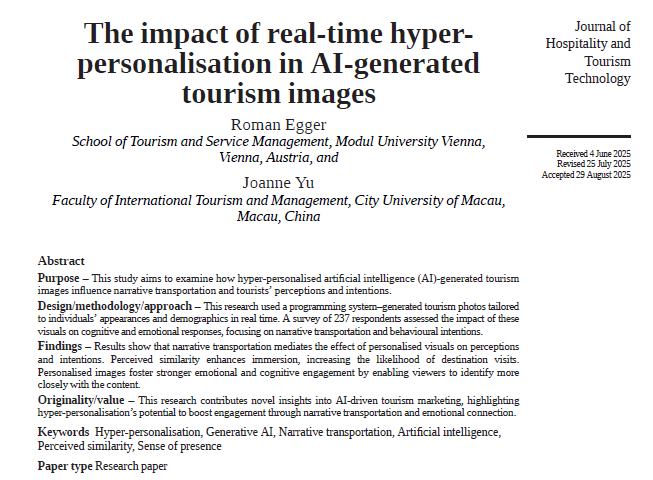
Together with my colleague Dr. Joanne Yu from the City University of Macau, I am pleased to announce our latest study for publication in the Journal of Hospitality and Tourism Technology.
In our research, we investigated how real-time generated, hyper-personalized tourism images influence the perceptions and intentions of potential travelers. Using an AI system, we presented 237 participants with individualized images depicting their own appearance in different travel scenarios.
Key findings:
The study shows that narrative transportation – the mental immersion in depicted scenarios – acts as a mediator between personalized visual content and tourist behavioral intentions. The more similar people recognized themselves in the AI-generated images, the stronger their emotional and cognitive engagement as well as their intention to visit the depicted destinations.
Interestingly, our analysis also revealed that increased trust in generative AI led to a decrease in emotional reactions and visit intentions – a paradox that may indicate a passive consumer attitude with overconfidence in technology.
Surprisingly, privacy concerns did not play a significant role in our context, which could indicate an increasing acceptance of personalized AI applications.
Implications for practice:
These findings open up new opportunities for destination marketing organizations and tourism platforms. Hyper-personalized, real-time generated content could revolutionize the way potential travelers explore destinations and make decisions.
Special thanks to the Macao Foundation for funding this research (Grant MF2310).
The full study is available at: DOI 10.1108/JHTT-06-2025-0464
No responses yet