
WebMCP: From Browsing to Delegation — How the Agentic Web Changes Tourism
The internet as we know it is undergoing a fundamental transformation.
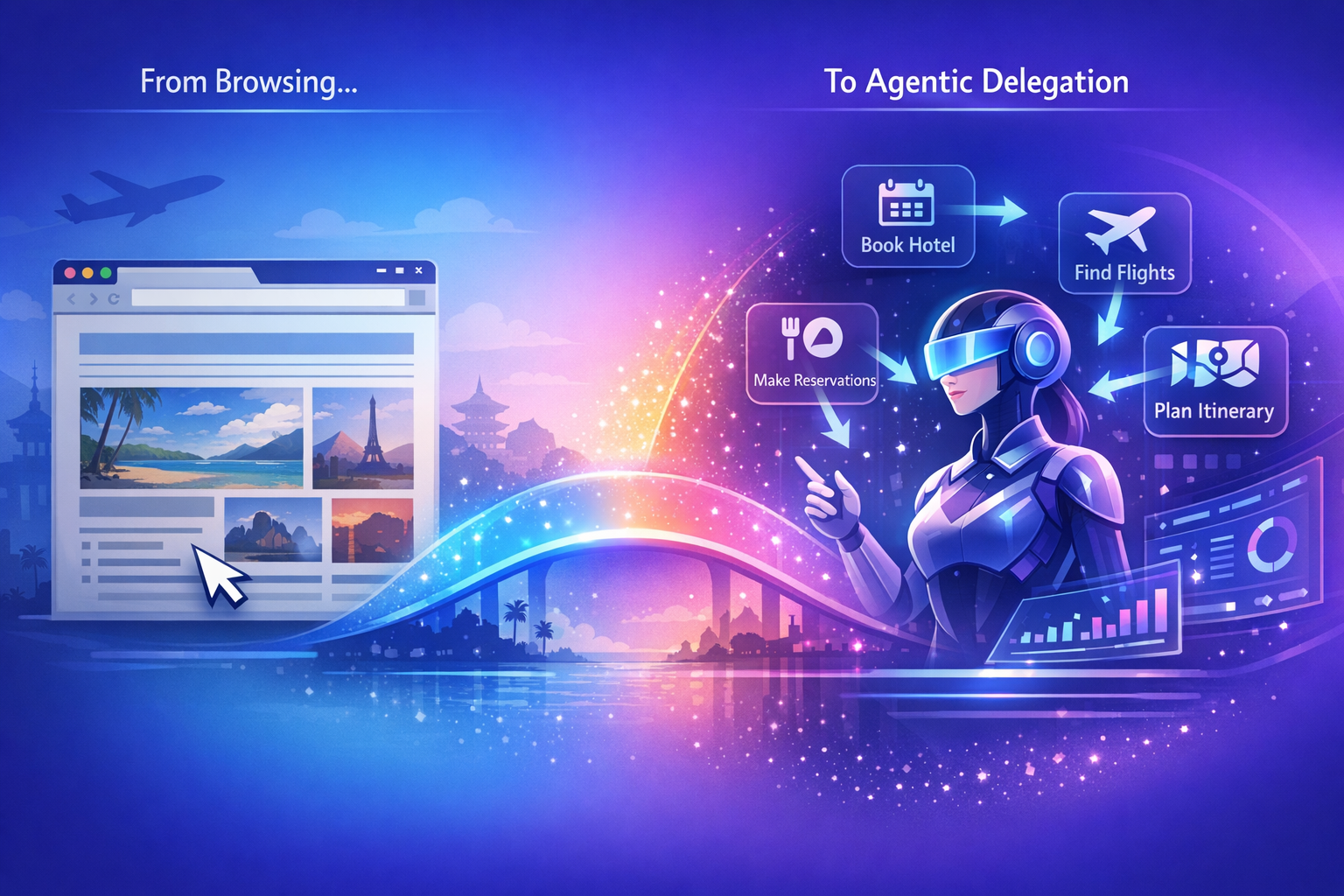
For three decades, the web was built for humans: visual, click-based, page-oriented. Now the paradigm is shifting radically. In the emerging agentic phase of the internet, it’s no longer just humans interacting with websites. Autonomous AI agents are taking over research, evaluation, and transactions. Browsing becomes delegation.
At the center of this evolution stands WebMCP — the Web Model Context Protocol. This new web standard enables websites to expose their functions in a structured, machine-readable way. For the tourism industry, this represents nothing less than a strategic redistribution of digital power.
The Problem: AI Systems as Blind Interpreters
Until now, AI systems had to “understand” websites the way humans do. They analyzed screenshots, identified buttons based on visual patterns, and attempted to fill forms pixel by pixel. This approach was computationally intensive, slow, and error-prone. A small design change could break the entire interaction logic.
This inefficient simulation of human clicking behavior is ending.
The Solution: From Visual Interpretation to Direct Execution
WebMCP eliminates the visual middleman. Instead of analyzing web pages, websites now declare their functions explicitly as structured tools.
A booking form is no longer understood as a collection of input fields, but as a clearly defined function with parameters and expected outputs. AI agents can execute these functions directly — no visual detours, no guesswork.
Technically, this happens in the browser. The browser becomes a mediating instance between agent and website, creating a controlled, secure space for machine interaction.
The shift is profound: From “read and click” to “understand and execute.”
Two Paths to Agent Capability
WebMCP offers two integration approaches:
1. The Declarative Approach (Lower Effort)
Extend existing HTML forms with additional attributes. This makes standard processes like searches or simple bookings agent-capable with relatively low effort. For hotels with existing booking flows, this is a pragmatic entry point.
2. The Imperative Approach (Advanced Use Cases)
Register complex functions via JavaScript, including detailed parameterization and asynchronous logic. This enables real-time availability checks, dynamic package configurations, or personalized offer combinations. For sophisticated direct distribution scenarios, this opens new possibilities.
Measurable Efficiency Gains
Early evaluations show significant effects:
- Computational cost: Drops dramatically (image processing is eliminated; only structured data is processed)
- Success rates: Rise substantially (~97% on complex tasks)
- Response times: Improve significantly
For tourism businesses, this is economically relevant. AI system costs correlate directly with processed data volume. Fewer tokens mean lower operating costs and faster response times. In an environment where milliseconds determine conversions, this is a strategic advantage.
What This Means for Hotels & Destinations
The agentification of the web creates a new competitive dynamic:
1. Structural Data Becomes Critical
Hotels and destinations that expose their functions via WebMCP become directly bookable by AI agents. Those that don’t risk invisibility in the agentic layer.
2. New Forms of Visibility
Being ranked in Google becomes less relevant if AI agents bypass search altogether. Visibility now means: “Can the agent book directly from my site?”
3. Direct Distribution Gets a Second Wind
Hotels no longer depend on OTA mediation. WebMCP-enabled direct booking becomes the path of least resistance for AI agents — and agents prioritize efficiency.
4. Personalization at Scale
Agents can negotiate custom packages, bundles, and pricing in real-time. The future is hyper-personalized, machine-to-machine commerce.
Direct Distribution Reimagined
WebMCP opens a historic opportunity for hoteliers. For decades, OTAs like Booking.com dominated the digital customer interface. With agent-based interactions, this power dynamic could shift fundamentally.
When a guest asks their AI assistant to book a room with specific criteria, the agent will soon access hotel website functions directly. The prerequisite: quality, structured data (Q-Data).
Without WebMCP, the response is generic. With WebMCP, it becomes concrete, binding, and transactionable. The difference isn’t in wording — it’s in data quality and structural connectivity.
Independent hotels gain access to technological infrastructure previously reserved for large chains and platforms. This is democratization of distribution power.
The USB-C Analogy
In industry circles, WebMCP is often described as the “USB-C connector for AI.”
Instead of individual interfaces between each system and each AI model, a universal standard emerges. A single implementation makes a website accessible to diverse agents in principle.
This forces hospitality software vendors to open their systems and design for interoperability. For independent hotels, this levels the playing field. For destinations, this means standardized machine-readable access to competitor functions.
Destinations as Data Orchestrators
For Destination Management Organizations, the role shifts fundamentally. It’s no longer enough to provide inspiring content. Destinations must become machine-readable and machine-tradable.
Via WebMCP, DMOs can expose functions far beyond pure information:
- Query trail conditions in real-time
- Check parking lot capacity
- Suggest alternative routes when hotspots are congested
- Operationalize visitor management
For alpine regions with sensitive ecosystems, this opens new possibilities for sustainable stewardship. AI-driven travel planning can respond to capacities in real-time and redirect guests intelligently.
The agent becomes a partner in sustainable destination management — not just a booking tool.
Technology and Authenticity
Despite all technological dynamism, tourism remains an emotional business. WebMCP optimizes transactions and logistics. Brand-building, storytelling, and authentic encounters remain human domains.
The strategic challenge lies in combining both:
- Transactional excellence through structured interfaces
- Emotional differentiation through authentic content
This balance determines competitive advantage in the agentic era.
Security and Data Protection
Autonomous agents inevitably raise questions about security and GDPR compliance.
In the WebMCP model, the browser assumes a central control function. Agents access only explicitly authorized tools. Sensitive actions like payments require user confirmation.
Technical mechanisms must ensure purpose-limitation, logging, and data minimization. Agentic systems need clear role models and transparent execution protocols.
Data protection becomes technical, not just legal. This is a fundamental shift in how privacy is implemented in the digital ecosystem.
From SEO to GEO
With the rise of autonomous agents, the logic of digital visibility changes fundamentally. Classic SEO targeted human clicks. In the agentic phase, it’s about Generative Engine Optimization (GEO).
What matters: Do AI models classify a source as trustworthy, structured, and transactionable?
WebMCP becomes the central instrument of this new visibility logic. Those who expose their functions in machine-readable form reduce interpretation ambiguity and increase the probability of being recommended by agents.
SEO is dying. GEO is being born.
Strategic Implications
The introduction of WebMCP is not merely a technical matter. It affects business models, power structures, and value chains.
If hotels and destinations actively implement the standard, they can regain some digital sovereignty. They reduce dependence on intermediaries and build direct relationships with agents (and through them, with customers).
If only platforms and intermediaries offer agent-enabled interfaces, power shifts further toward centralized gatekeepers. OTAs transform from booking channels into the only “visible” layer in the agentic economy.
The decisive question is therefore not whether the agentic web is coming. It is: Who shapes it?
Those who move early don’t just adopt a new standard. They participate in redefining the power dynamics of digital tourism.
The Choice Ahead
WebMCP is a technical standard. But it’s also a political choice.
Will tourism remain fragmented, fighting for visibility in intermediary-controlled channels?
Or will hotels, destinations, and independent operators reclaim their digital agency by building agent-ready infrastructure themselves?
The technology is ready. The business case is clear. The competitive window is open.
The time to decide is now.
Next Steps
The WebMCP standard is still emerging, but adoption is accelerating. Hotels and destinations should:
- Audit current systems: Which functions could be agent-exposed?
- Prioritize low-hanging fruit: Booking, search, availability checks
- Invest in data quality: Structured, consistent, current information
- Plan for imperative complexity: Custom packages, dynamic pricing, personalized offers
- Test early: WebMCP prototypes are available now
- Build partnerships: Work with software vendors who embrace the standard
The agentic web isn’t coming. It’s here. The question is: Are you visible in it?
And more importantly: Are you ready to shape it?
Get Ahead of the Curve
At Smartvisions, we help tourism organizations understand, strategize, and implement AI-driven transformation — including agent-readiness, data quality frameworks, and GEO strategies.
If you want to be at the forefront of this shift, let’s talk.
[Contact Roman Egger for Strategy Consultation]
No responses yet